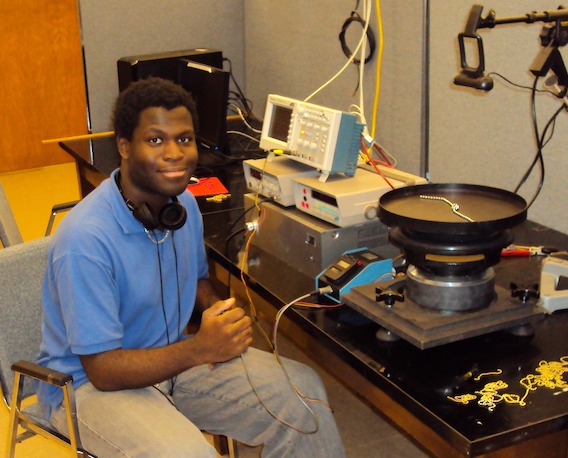
KNOT: Knots and topological transformations in vibrating chains
How knots tied in metal chains untie themselves when vibrated is way to study how important
macromolecules such as polymers and DNA tangle and untangle. Nontrivial knots of one-dimensional objects only exist in three spatial dimensions, which may explain why our universe has three dimensions.
In this seemly simple experiment you will explore the challenging mechanics and thermodynamics of linear chains. The experiment is originally based on Knots and
Random Walks in Vibrated Granular Chains, E. Ben-Naim et al., Phys. Rev. Lett. 86 (2001) 1414.
(The experiment is currently located in MP239; last write-up revision: September 2015.)
Additional resources:
Possibly useful Python software which you can use/modify:
Numerical solution of Ben-Naim's equations (3) and (4):
unknotting_time.py.
A simple Monte Carlo simulation of Ben-Naim's unknotting model:
knot_random_walk.py.
A vPython simulation of a beaded chain unknotting on a vibrating plate:
beaded_chain.py.
New (2021) Python code is available to calculate Radius of Gyration from mpeg videos of the chain: Python_ROG.zip, with contributions from student Gabriel Bailey.
Older Windows-only Python software that uses a webcam to measure and plot the radius of gyration of a beaded chain in real time, written by students Jamie Woodbury and Anselm Hui: RealTime_ROG.zip. This is Python 2 legacy code that has not yet been updated to work in Python 3, so a Python 2.7 installation is needed. (If using Anaconda Python, it is easy to switch between Python 2 and Python 3.)
Older MatLab software written by student Nikita Reznik
to measure the radius of gyration of a reflective chain as it
lies on a black background.