LAUE: Laue Back-Reflection of X-Rays
X-rays scattering is one of the most powerful methods used worldwide to understand the structure of materials, from high temperature superconductors to proteins and other macromolecules. This experiment primarily looks at crystal planes in single crystals using a technique involving constructive interference of X-rays.
Max von Laue won the Nobel Prize in Physics in 1914 "for his discovery of the diffraction of X-rays by crystals". Other Nobel Prizes involving crystallography include Lawrence Bragg and William Bragg (Physics 1915), Peter Debye (Chemistry 1936), Watson, Crick, and Wilkins (Medicine 1962), Dorothy Hodgkin (Chemistry 1964), Bertram Brockhouse and Clifford Shull (Physics 1994), Ramakrishnan, Steitz, and Yonath (Chemistry 2009), Dan Shechtman (Chemistry 2011), and many more
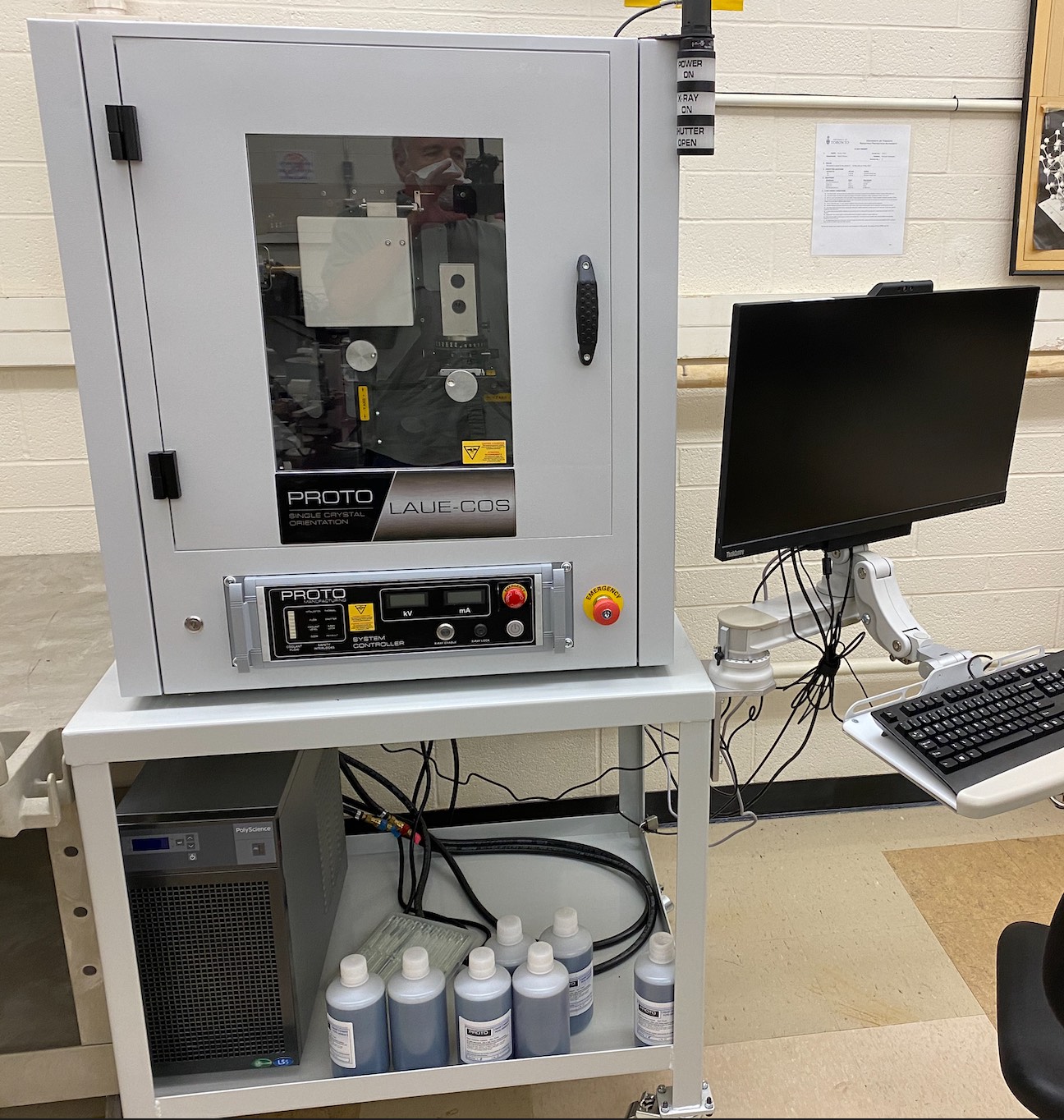
A new Proto Laue-COS Benchtop diffractometer was installed in February 2022. This is a newly developed Benchtop version of the Proto Laue-COS system.
This is a brand-new apparatus and there is not yet an updated write-up. The old write-up and new instrument manuals (below) are the current primary resources.
Old Write-Up in PDF Format or Microsoft Word Format.
(The experiment is currently located in MP226)
Proto Laue COS Manuals on Quercus
These are for APL use only and must not be copied or distributed.
Additional resources:
- – Material and crystal properties:
- Crystal Structures of the Elements.
- X-Ray attenuation lengths
- To indelibly remember the CaF2 crystal structure studied in this experiment, watch Scott Ramsey from the Department of Materials Science and Engineering create a model using oranges and limes.
- Something a little different to try: "Crystallization of a Rubber Band by Stretching", "Strain-Induced Crystallization of Natural Rubber: a Review of X-ray Diffraction Investigations".
- – Analysis software:
-
Laue_Spot_Identify.py is a python script for cubic crystal lattices that given a sufficient number of spot positions on a planar Laue image, can determine their hkl indices. How to use Laue_Spot_Identify is explained in its comments.
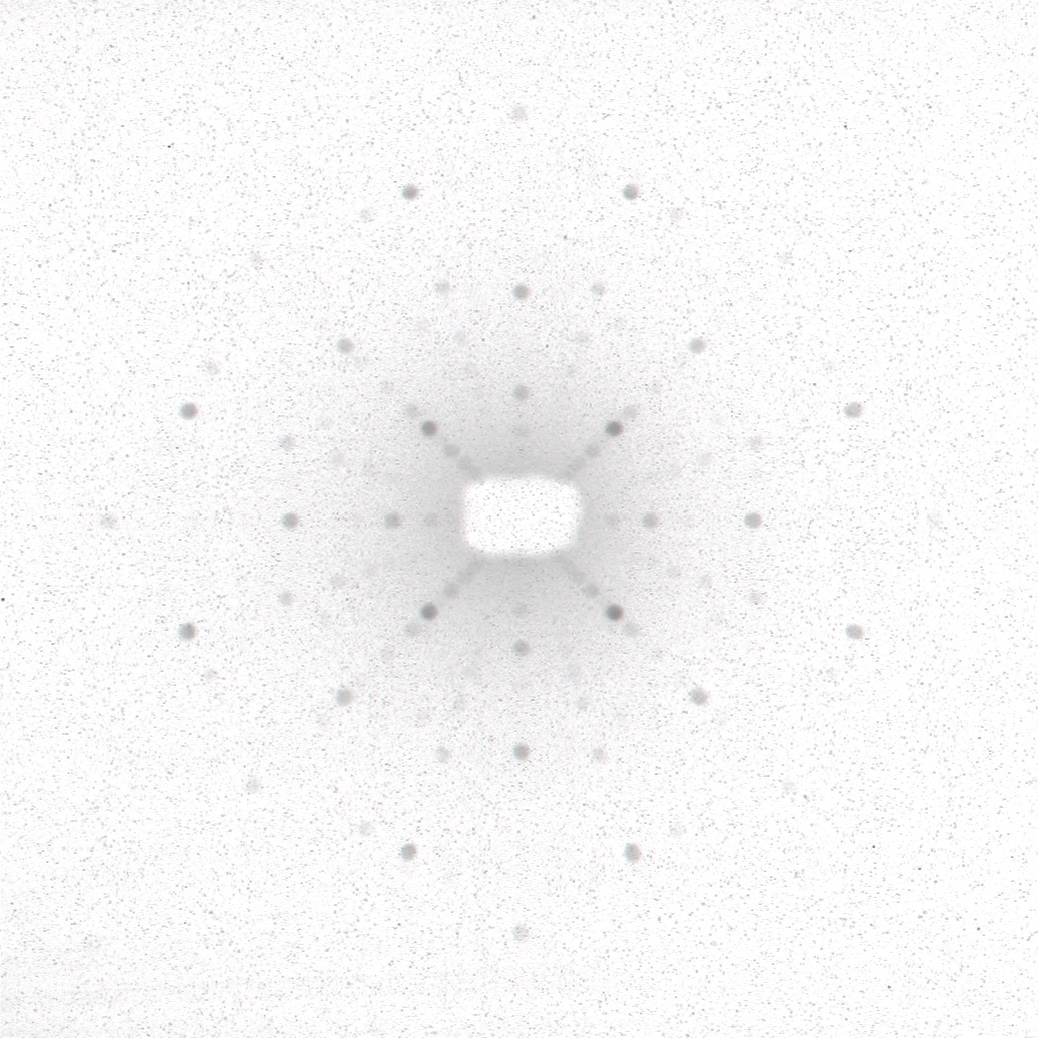
- Laue_Data.txt is a sample data file for this script, based on the Laue image below (Example_W001_45kV_18mA_30mm.jpg), which can be further examined by opening Example_W001_45kV_18mA_30mm.xtl in QLaue.
- All that is needed to run it on data from your images is to edit Laue_Data.txt with the parameters for your images.
- Laue_Spot_Patterns.py is a python script that will plot spot patterns for simple cubic, face-centred cubic, and body-centred cubic crystal lattices. How to use Laue_Spot_Patterns is explained in its comments. Improvements or modifications are welcome.
-
QLaue (for Windows or Mac) simulates back reflection Laue diffraction images, allows rotations and overlaying actual Laue images. Some help with QLaue is found in QLaue_Notes, available in either doc or pdf format.
- A sample file based on the example data given within Laue_Spot_Identify.py that can be opened in QLaue is Example_W_Random_QLaue.xtl.
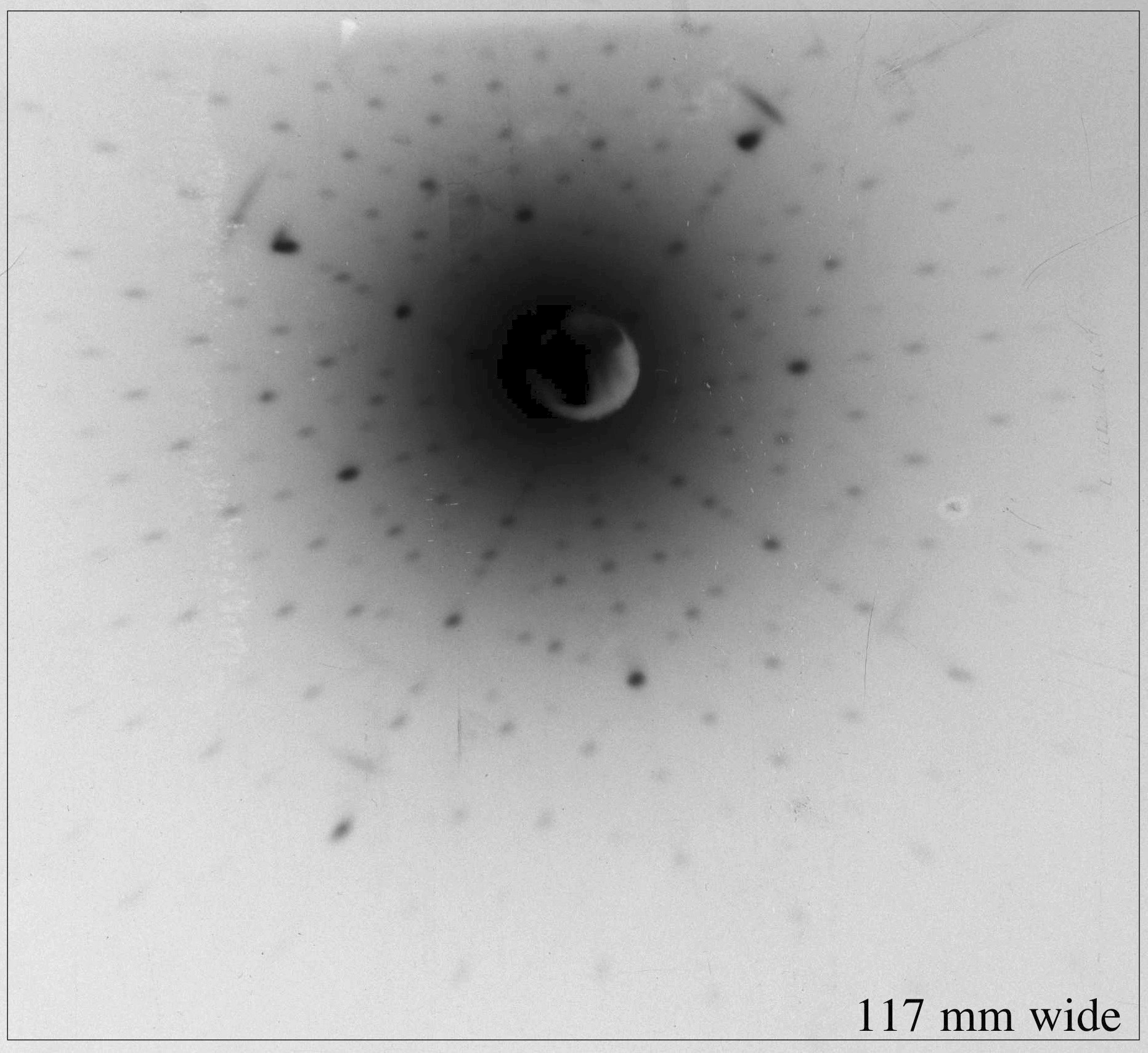
- The CaF2 discussed in the experiment writeup is Example_CaF2.xtl (based on Laue image Example_CaF2.png.)
-
Laue_Spot_Identify.py is a python script for cubic crystal lattices that given a sufficient number of spot positions on a planar Laue image, can determine their hkl indices. How to use Laue_Spot_Identify is explained in its comments.