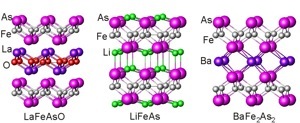
High temperature superconductivity was discovered in certain copper oxide based materials (left) nearly 25 years ago, with transition temperatures reaching as high as 150K for some materials in this class. More recently, the iron-arsenide sueprconductors (above) have generated a lot of excitement in the field of correlated high temperature superconductvity.


With the aim of understanding the physical properties of the copper oxide superconductors, we have studied Gutzwiller type variational wavefunctions for the superconducting state with the idea that it arises from doping a Mott insulating state. We found that a number of results from such an approach - the competition between superconductivity and antiferromagnetism, the rise and fall of superconducting order with hole doping, the small superfluid density, the quasiparticle velocity - are all in very good agreement with experimental data.
. A Variational Wavefunction Approach to the Cuprate Superconductors
A.Paramekanti, M. Randeria, N. Trivedi, Phys. Rev. Lett. 87, 217002 (2001)
A.Paramekanti, M. Randeria, N. Trivedi, Phys. Rev B 70, 054504 (2004)
We have also explored a number of phenomenological approaches to other issues in this system - such as the nature of phase fluctuations, and a possible connection between Fermi arcs observed in photoemission experiments and the superconductor-insulator transition at low doping.
. Phase Fluctuations in the Layered Cuprate Superconductors
A.Paramekanti, M.Randeria, S.S.Mandal, T.V.Ramakrishnan, Phys. Rev. B 62, 6786 (2000)
L.Benfatto, S.Caprara,C.Castellani,A.Paramekanti,M.Randeria, Phys.Rev.B 63, 174513 (2001)
. Fermi Arcs and the Superconductor-Insulator Transition at Low Doping
A.Paramekanti, E. Zhao, Phys. Rev. B 75, 140507(R) (2007)