Lasers system

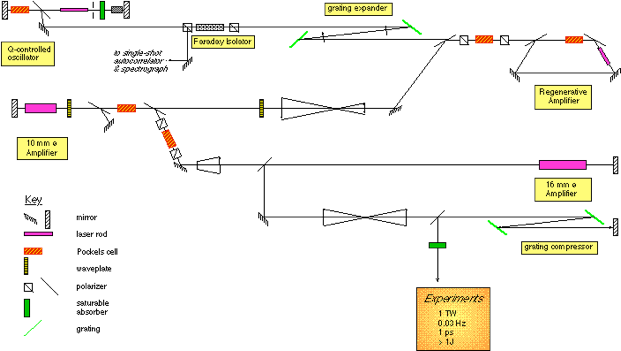
New physics often follows qualitatively new techniques. In optical physics, one of these developments has been the introduction of 'chirped-pulse amplification' (CPA) lasers, which have permitted peak laser powers to increase by more than three orders of magnitude, practically overnight. At Toronto, we have built a CPA laser system which produces a pulse a fraction of a picosecond in duration, but nonetheless contains more than a joule of energy-for a peak power greater than a trillion watts, and capable of a focussed intensity greater than 1018 W cm-2.
Toronto's FCM-CPA Terawatt Laser System
Pulse Contrast
One of the important aspects of the interaction of high-intensity laser light with matter, particularly solids, is the 'pulse contrast' -- a measure of the amount of energy deposited on the target before the arrival of the peak of the laser pulse. The output of the Toronto FCM-CPA terawatt laser is one of the most intrinsically 'clean' ultrahigh intensity pulses produced in this research field, due to two aspects of the oscillator.
Our prototype or seed pulse is produced by a feedback-controlled oscillator, an active/passive modelocked, flashlamp-pumped Nd:glass system which produces a train of microjoule-energy 1 ps pulses. This pulse is grating-expanded, amplified and grating-compressed. Because the recompressed pulse cannot passively be improved over the original pulse, the very good contrast of the oscillator pulse is an important part of the system's final output characteristics. And because the energy of this pulse is several orders of magnitude greater than is typical for such CPA systems, less amplification is needed in the first stage, the regenerative amplifier. In this, the spectral characteristics of the pulse are less degraded, and, as well, less amplified spontaneous emission results, with the result that the background prepulse or pedestal of the final pulse is much improved.
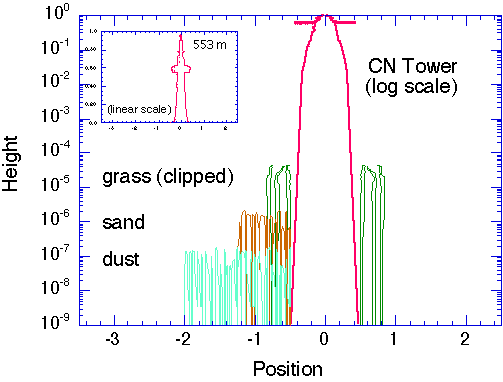
To put this into perspective, our pedestal prepulse is less than 5 x 10⁻⁸ of the pulse peak intensity -- compare this with the ratio of the heights of grass and gravel surrounding Toronto's CN Tower, the world's tallest free-standing structure: