 PHY385 Module 6
Student Guide
Concepts of this module
External
reflection. Spherical mirror equation.
Total
internal reflection.
Colors
formation.
Quiz

Activity 1 - External reflection. Spherical mirror equation.
EQUIPMENT NEEDED:
- Optics Bench
- Light Source
- Component Holder (3)
- 50 mm F. L. Spherical Mirror
- Viewing Screen
- Crossed
Arrow Target.
Parallel
rays can be brought to a focus by a reflective paraboloid of revolution. For rays close to the optical axis, a
paraboloid of revolution can be approximated
by a spherical surface. In this activity, you will investigate an image created by a concave spherical mirror and verify the mirror equation.

a)
Set
up the equipment as shown in Fig.1, with the concave side of the mirror facing the Light Source. The Viewing Screen should cover only half the hole in the Component Holder so that light from the filament reaches the mirror.
b)
Adjust
the position of the mirror until there is a well focused image of the crossed arrow target on the viewing screen.
c)
Make
measurements of so and si for
four or five values of so. Show the table of measured values.
d)
Plot
1/so versus 1/ si
and find the best fit line.
e)
Using
the fitter, calculate the focal length of the spherical mirror.
f)
Rearrange
the experiment by removing the Viewing Screen and observing the image on the surface
of the crossed Arrow Target. Find the focal length of the mirror from this measurement.
g)
Compare the two experiment results and the given value for f . Which method of measurement is more accurate? Why?
h)
From this, what do you expect is the radius of curvature of this mirror?

Activity 2 - Total internal reflection.
EQUIPMENT
NEEDED:
-Optics Bench
-Light Source
-Ray Table and Ray Table Base
-Component Holder
-Slit Plate
-Slit Mask
-Cylindrical Lens
-Ray Table Component Holder
-Viewing Screen.
Set up equipment as shown in Fig. 2,
so a single light ray is incident on the curved surface of the cylindrical
lens.
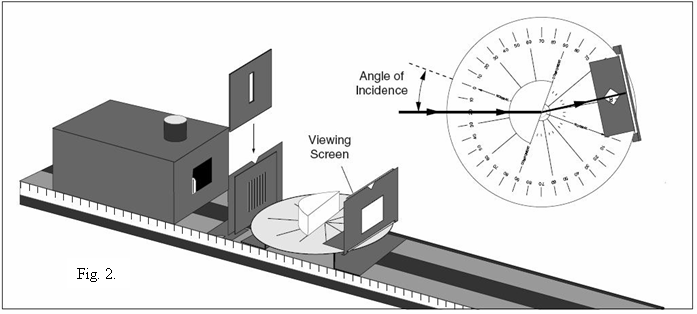
a) Set the Ray Table so the angle of incidence
of the ray striking the flat surface of the lens (from inside the lens) is
zero-degrees. Adjust the Ray Table Component Holder so the refracted ray is
visible on the Viewing Screen.
b) Slowly increase the angle of
incidence on the interface acrylic/air. As you do, watch the refracted ray on
the Viewing Screen. Notice that not all of the light in the incident ray is
refracted. Part of the light is also reflected. From which surface of the lens
does reflection primarily occur?
c) Are the angles of the reflected ray
consistent with the law of reflection?
d) How does the intensity of the
reflected and refracted rays vary with increasing the angle of incidence?
e) At what angle of incidence is all
light reflected?
f)
Measure
and calculate the critical angle for the total internal reflection.
g) What happens with the incident ray
if you continue increasing the incident angle?
h) Does the internally reflected ray
obey the law of reflection?
Activity 3 - Colors formation
Early investigators assumed that
light, in its purest, simplest form is white; and that refractive materials
alter the characteristics of the white light to create the various colors. Sir
Isaac Newton was the first to show that light, in its simplest form, is colored; and that refractive materials merely separate the
various colors which are the natural constituents of white light. He used this
idea to help explain the colors of objects.
EQUIPMENT NEEDED:
- Same as in Activity 3
- Three Colored Filters
To perform the experiment, use the setup
depicted at Fig. 2. The single ray of light should pass through the centre of
the Ray Table.
a) Slowly rotate the Ray Table to
increase the angle of incidence of the light ray.
b) Examine the refracted ray on the Viewing Screen.
c) Notice the colour separation at large
angles of refraction
and record the angle of incidence at which the color separation is a maximum.
Write the order the colors appear in the refracted beam starting with the color
that experienced the smallest deflection.
d) Use your observations to confirm
To continue the experiment, arrange
the Cylindrical Lens so that the three central light rays (the red, the green
and the blue) intersect at precisely the same point on the Ray Table (see Fig.
3).

What color of light results when
red, green, and blue light are mixed? How does this support
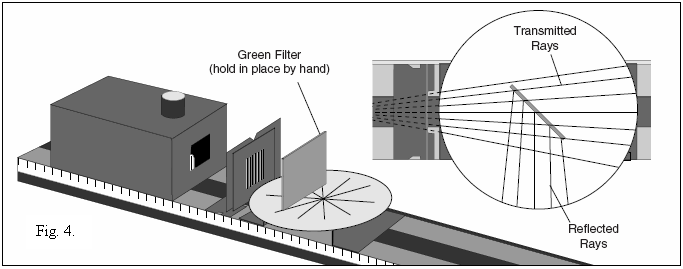 To study the
formation of colors of objects, set up equipment as in Fig. 4.
To study the
formation of colors of objects, set up equipment as in Fig. 4.
a) Observe the light rays
that are transmitted through the Green Filter. What color are the transmitted
rays?
b) Observe the light
rays reflected from the Green Filter. What color are the reflected rays?
c) Combine the red
filter and the green filter so the light passes first through the Green Filter
and then through the Red Filter. Look into the Green Filter. What color rays
are reflected from the front surface of the Green Filter? Which rays are
reflected from the front surface of the Red Filter?
d) Place the Blue
Filter over the Light Source aperture so the incident rays are blue. Let these
rays pass through the Green Filter only. What colors are the reflected rays
now?
e) Based on your
observations, conclude on what makes the Green Filter appear green.
f)
What makes a green leaf appear green?
This Student Guide was created by Natalia
Krasnopolskaia in October 2014.