 PHY385 Module 8
Student Guide
Concepts of this module
Coherent waves.
Phase difference and optical path difference.
Superposition of
coherent waves traveling the opposite directions. Standing waves.
Superposition of
two incoherent waves. The beats.
Superposition of
two coherent waves.
Quiz

Activity 1 - Coherent Waves. Phase
difference and optical path difference (OPD).
Coherent
waves have equal frequency and wavelength. Their phase difference is constant
in time.
Problem 7.6.
Two
coherent waves are traveling in parallel directions (see Fig. 1).

Determine
the optical path difference for the two waves A and B, both having vacuum
wavelength of 500 nm. The glass (n = 1.52) tank is filled with water (n =
1.33). If the waves start out in-phase and all number are exact (the
uncertainties are zero), find the phase difference Δα = α2
- α1 and the OPD for
the two waves at the finish line.
Activity 2 -
Superposition of coherent waves traveling in opposite directions. Standing
waves.
When a
traveling wave is reflected from a stop, the standing wave appears as a sum of
the traveling and reflected coherent waves of same amplitude (in absence of
absorption). The resultant is a standing wave that does not transfer energy and
has zero amplitude at specific locations called the nodes.
Problem 7.13.
Microwaves
of frequency 1010Hz are beamed directly at a metal reflector.
Neglecting the refractive index of air, determine the spacing between
successive nodes in the resulting standing-wave pattern.
Activity 3 -
Superposition of two incoherent waves. The beats.
When a
sensor can detect simultaneously two waves with slightly different frequencies,
the resultant disturbance in the location of the sensor is called a beat. The beats of two incoherent
harmonic waves with same amplitude E01
traveling in the positive x-direction
are shown in Fig.2. The result of superposition is a traveling wave E = E0 (x,t) cos (kx - ωt),
where E0 = 2E01 cos (kmx
- ωmt); k = ½ (k1+ k2); ω = ½
(ω1 + ω2); km = ½ (k1
- k2); ωm = ½ (ω1 - ω2),
(if ω1 > ω2, and k1> k2). The beat frequency is given by ωb = ω1 - ω2.

Problem 7.15.
Imagine
that we strike two tuning forks, one with frequency 0f 340 Hz, the other 342
Hz. What will we hear?

Activity 4 - Superposition of two
coherent waves.
EQUIPMENT
NEEDED:
- Optics
Bench
- Light
Source
- Ray Table
Base
-
Diffraction Scale
- Slit Mask
- Diffraction
Plate
- Red Color
Filter
- Component
Holder
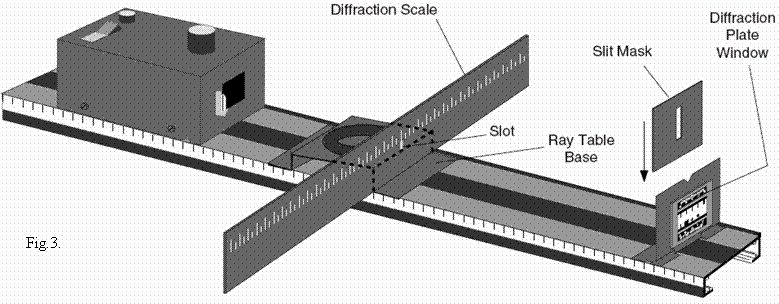
1. Mount
equipment on the Optics Bench as shown in Fig.3.
2. Before mounting the Diffraction Plate,
center the Slit Mask on the Component Holder on the side facing the Light
Source.
3. While looking through the Slit Mask,
adjust the position of the Diffraction Scale so you can see the filament of the
Light Source through the slot in the Diffraction Scale.
4. Attach the Diffraction Plate to the
other side of the Component Holder, as shown. Center pattern D, with the slits
vertical, in the aperture of the Slit Mask. Look through the slits. By
centering your eye so that you look through both the slits and the window of
the Diffraction Plate, you should be able to see clearly both the interference
pattern and the illuminated scale on the Diffraction Scale.
In the two-slit experiment, the light wave
first falls on a Slit Mask and then on an opaque screen - the Diffraction Plate
- with two closely spaced, narrow slits. As Huygens's principle tells us, each
slit acts as a new source of light. Since the slits are illuminated by the same
wave front, these sources are coherent and in phase. At the location where the
wave fronts from the two coherent sources overlap, the superposition of the two
waves results in the interference pattern that can be observed either on a
screen or directly by eye. NOTE:
In this experiment,
you look through the narrow slits at the light source, and the interference
pattern is formed directly on the retina of your eye (Fig. 4). You then see
this interference pattern superimposed on your view of the illuminated
diffraction scale.

Fig.4.
The goal of
your measurements is to determine the wavelength of light that creates an
interference pattern on your retina. The irradiance of the image is
proportional to the E2.
For the
amplitude in a point of observation, the result of superposition of the two
coherent waves can be written as

where 2E01E02
cos(α1 - α2) is an interference
term. For the waves with equal amplitude E01
 .
.
When α1 - α2 = 2nπ, n
= 0, 1, 2,..., the interference term is at maximum, and you can see the bright
line with irradiance that is four times the irradiance of a single source.
When α1 - α2 = (2n + 1)
π, n = 0, 1, 2,..., the interference term is at minimum, and you
see the zero irradiance at the location of superposition of the waves.
The phase
difference α1 - α2 is related to the OPD
as you have found in Activity 1.
Looking
through the pair of slits (pattern D) at the Light Source filament, make
measurements as explained below with a red filter placed over the Light Source
aperture and fill in the table. The value for L of 450 mm is recommended, but can be different in your
experiment.
At the zeroth maxima, light rays
from slits A and B have traveled the same distance from the slits to your eye,
so they are in phase and interfere constructively on your retina. At the first
order maxima (to the left of the viewer) light from slit B has traveled one
wavelength farther than light from slit A, so the rays are again in phase, and
constructive interference occurs at this position as well.
At the nth order maxima, the light from slit B has traveled n wavelengths farther than the light
from slit A, so again, constructive interference occurs. In the diagram, the
line AC is constructed perpendicular to the line PB. Since the slits are very
close together (in the experiment, not the diagram), lines AP and BP are nearly
parallel. Therefore, to a very close approximation, AP = CP. This means that,
for constructive interference to occur at P, it must be true that BC = nλ.
Notice that θ = arctan X/L, and AB sin (arctan X/L) = nλ.
.
|
Color |
n |
AB (mm) |
X (mm) |
L (mm) |
Wavelength (nm) |
Average (nm) |
|
red |
1 |
0.125 |
|
450 |
|
|
|
|
2 |
0.125 |
|
450 |
|
|
|
|
3 |
0.125 |
|
450 |
|
|
This Student Guide was created by Natalia Krasnopolskaia
in November 2014.