 PHY385 Module 9
Student Guide
Concepts of this module
Polarization of
light transmitted through a dichroic material (Polaroid film).
Malus's Law.
Polarization by
reflection. Brewster's angle.
Quiz

Activity 1 - Calibration of the Light Sensor.
EQUIPMENT NEEDED:
-Optics Bench
-Light Source
- Diode laser
-Polarizers (2)
-Component Holders (3)
-Ray Table and Base
-Ray Table Component Holder
-Cylindrical Lens
-Crossed Arrow Target
-Slit Plate
-Slit Mask
-Light
Sensor attached to a stand.
The PASCO Light Sensor CI-6504A is
shown in Fig.1.

The sensor measures relative illuminance
for a spectrum in a range of 320 nm - 1100 nm. In photometry, illuminance
is the total luminous flux incident on a surface, per unit area. It is a
measure of how much the incident light illuminates the surface,
wavelength-weighted by the luminosity function to correlate with human
brightness perception. In SI derived units these are measured in lux (lx). Luminosity
function approximates the response of the human eye to power of the light of
different wavelengths.
The gain switch changes the maximum
light intensity as follows:
1xGain, 500 lux;
10xGain, 50 lux;
100xGain, 5 lux.
The latter provides the greatest
possible sensitivity if the light intensity is very low.
In some parts of this experiment the
luminosity is low, thus the sensitivity must be the greatest possible.
Despite the fact that the
illuminance is measured in lux, the value you will read is in volts. This
conversion made by the interface, does not change any conclusion you can make basing
on your measurements.
You must calibrate the sensor before
using it for the first time.
Connect the DIN connector to the Light
Sensor, and the interface connector plug into the A input of the Data Acquisition
Device. The Data Acquisition Device is the computer interface.
On the desktop of your computer find
an icon "2nd year files" at the left bottom corner and click on it
to turn on the data acquisition process. You will see numbers in volts. If you
shade the photodiode aperture, the readings will still be non-zero and
fluctuating very rapidly.
For each
gain, find the zero by closing the aperture of the diode and measuring the
offset of the sensor for this gain.

Activity 2 -
Polarization of light transmitted through a dichroic
material (Polaroid film).
 Assemble the optical equipment as
shown in Fig. 2.
Assemble the optical equipment as
shown in Fig. 2.
For each exercise you will need just
some of the shown elements of the optical system. The Light sensor must be
mounted on the holder and its collimator with aperture must be directed towards
the light source. The Crosse Arrow Target produces a narrow light beam, which
is easy to detect.
You
will need one polarizer for this exercise. The Polarizer B should be temporary
removed from the Optics Bench.
Study
the incandescent lamp in the Light Source and the Light Diode with the Light
Sensor in two steps: first without, next with the polarizer in between the
light source and the Light Sensor. The polarizer you are using is a film called
Polaroid. Record your results for future calculations. Conclude on
(a)
a possible kind of polarization of light of each source and
(b)
on a coefficient of attenuation of the polarizer (the Polaroid film).
Activity 3 - Malus's Law
Use the
incandescent lamp as a source for this experiment. Insert two polarizers
between the source of the light and the Light Sensor. Assemble the pair of
polarizers in such a way that the reading of the Light Sensor is at maximum. This
corresponds to the parallel transmission axes of the two polarizers. Identify
and record the positions of the transmission axes for your future measurements.
If the Crassed Arrow Target dramatically reduces illuminance of the detector,
remove it from the Optics Bench. In your notebook, prepare a table for values
of measured angles θ between the axes of the two
polarizers in the range of angles from 0 to 180o; the measured illuminance for each angle in volts; and the
(cos θ )2. Slowly rotating one of the polarizers, record the
step-by-step readings of the Light Sensor. Fill in the table and graph two
functions: "illuminance vs. θ" and "illuminance vs. (cos θ)2". Using your results of the exercise 3, suggest an
analytical expression for the relationship among the illuminance given by the
primary beam of light; the illuminance, detected by the Light Sensor after
passing the two polarizers; and the angle between the transmission axes of the
two polarizers. It will be your discovery of Malus's law!
Activity 4 - Polarization by
reflection. Brewster's angle.
The Brewster's angle of incidence of
non-polarized light on the surface separating two media with different indices
of refraction results in the fully polarized reflected light. In this case, the
refracted and reflected rays are perpendicular to each other.
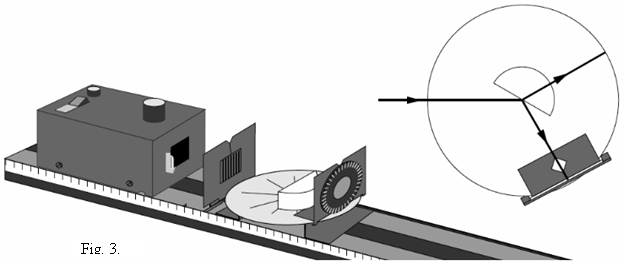
1. Using
the cylindrical lens, assemble a setup as shown in Fig. 3.
2. Place a polarizer on the way of the reflected
ray and the Light Sensor behind the polarizer.
3. Slowly rotate the polarizer to observe the
change in the illuminance due to the change of the direction of the optical
axis of the polarizer.
4. Give your conclusion on whether this position
corresponds to the incidence under the Brewster's angle. Record the Brewster's
angle in your notebook..
If the
angle of incidence needs adjustments, get the maximum possible reading of the Light
Sensor in the initial position of the lens, and then try to slightly change the
angle of incidence and observe the change in the measured illuminance. After
you find the perfect position of the lens, use the Brewster's angle to calculate
the index of refraction of the lens and show your work.
Replace the
incandescent lamp by the diode laser and repeat your measurements. What is the
main difference in the results of experiments with the incandescent lamp and
the laser in this exercise?
.
This Student Guide was created by Natalia Krasnopolskaia
in November 2014.