
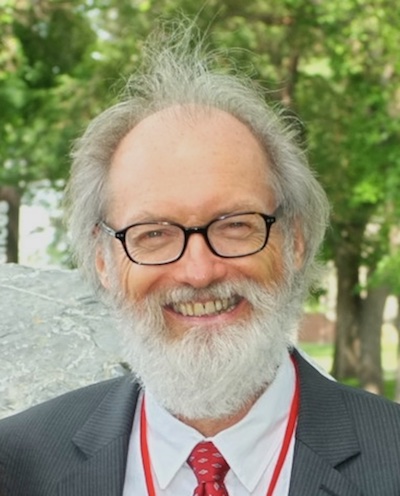
John Martin
Professor and IPP Principal Research Scientist, Emeritus
Research Interests
In recent years I have been working on 2 particle physics experiments, ZEUS in Germany and T2K in Japan. (Previously I was involved with many experiments at the Rutherford Laboratory, Argonne National Laboratory and Fermilab, as well as in test beams at CERN, studying the interactions of pions, photons and neutrinos with protons.)
ZEUS: My interest for many years was deep inelastic lepton-nucleon scattering, an important process for revealing the structure of the proton and understanding aspects of the gauge theories of particle physics at the quark/lepton level. The latest generation of such experiments has been performed at HERA, a unique high energy electron-proton collider and the world's highest energy "electron microscope". HERA was built by several countries including Canada at the DESY laboratory in Hamburg, and ran from 1992 to 2007. The centre of mass collision energy was 320 GeV, giving a view into the quark and gluon sub-structure of the proton at a distance scale approaching 10-18 cm. The proton is held together by the strong interaction, the theory of which is called quantum chromodynamics or QCD, and HERA has provided a fertile laboratory for critical tests of QCD. Also at this previously unattainable tiny distance scale, hints of the new physics necessary to resolve problems raised by the current Standard Model of particle physics were anticipated. However, so far the standard model reigns supreme (apart from neutrino oscillation, see T2K below), and the LHC at CERN, after first discovering the Higgs Boson, is currently taking up the challenge to find new physics at even smaller distance scales for the next decade or two.
Our Canadian group from from McGill, York and Toronto collaborated with other physicists from 12 countries on the design, construction and operation of a huge detector called ZEUS to observe the ep interactions. We designed and built a major part of the 300 tonne high precision calorimeter necessary to measure the energy and direction of the jets of particles emerging along the directions of the quarks and gluons scattered out of the proton by the electron. We also provided the third and highest level of the complex trigger system, which separated interesting physics events from a much greater number of background collisions.
In 1995 we constructed an important upgrade to the ZEUS detector, a 10 tonne calorimeter to detect forward scattered neutrons from the ep collisions. This project was instigated by Dr. G. Levman in our Toronto group and has allowed us to probe the structure of the pion. A useful mental picture to understand this idea is that the proton occasionally "mutates" into a neutron and a positively charged pion. The electron then scatters from the pion rather than the original proton.
For the final years of operation HERA was reconfigured to increase the collision rate by a factor of 5 and to provide longitudinal polarization of the electron beam. ZEUS was also upgraded; we designed and built a new third level trigger system, and collaborated with York University in building and commissioning new tracking detectors to improve particle tracking in the forward region of the experiment. Analysis of the large data-set from the final years is mostly complete, including combining results with the other collider experiment at HERA, H1, in order to provide the most precise understanding possible of the internal structure of the proton. Analysis of data to study further QCD topics will continue into the future, but my association with ZEUS came to an end in 2014.
T2K: I am also a member of the T2K neutrino oscillation experiment in Japan. One of the most exciting discovery in particle physics, by the Super-Kamiokande (SK) experiment in Japan and the SNO experiment here in Canada, has been that neutrinos oscillate or transform from one of the three types (electron-, muon- and tau-neutrinos) to another as they travel. This quantum-mechanical process requires that the neutrinos have mass, a new feature of physics "beyond" the Standard Model, in which neutrinos were considered massless particles.
Neutrino Oscillations won the big physics prizes recently: the 2015 Nobel Prize to Takaaki Kajita and Art McDonald and the 2016 Breakthrough Prize in Fundamental Physics to all the physicists on 5 experiments, Super-K, SNO, KAMLAND, K2K/T2K and Daya Bay.
The T2K design goal was to measure the most important remaining parameter of the neutrino oscillation physics, which is a "mixing angle" involving the transition from muon-neutrinos to electron-neutrinos. If the strength of this transition is non-zero (it was known pre-T2K that it is quite small or possibly even zero), it would be possible to search for a violation of matter - antimatter symmetry, called "CP", in the neutrino sector, by comparing oscillation results from neutrino and anti-neutrino beams. This is vitally important for understanding the deep mystery of how the universe became dominated by matter over anti-matter shortly after the BIG BANG. (Fortunately this happened, or we matter creatures wouldn't be here to cogitate upon such profound questions...!)
T2K directs a beam of muon-neutrinos from the J-PARC laboratory to SK, a distance of 295 km, where we search for the appearance of electron-neutrinos. The Canadian group on T2K involves physicists from TRIUMF and five universities, Victoria, UBC, Regina, Toronto, York. We designed and built many important parts of the neutrino beam monitoring systems and the "near" detector at 280m from the neutrino production target, which measures the flux and direction of the neutrinos before they have a chance to oscillate. During 2009 we installed and commissioned these detectors in Japan and the first neutrino events were seen on November 22, 2009.
The huge earthquake in March 2011 interrupted the T2K data-taking and caused considerable damage to the accelerator complex and the experiment. However, after a major recovery effort data-taking resumed in early 2012 and has continued since, including a run with an anti-neutrino beam in 2014.
In 2011 T2K released a ground-breaking PRL paper on electron-neutrino appearance based on the data taken before the earthquake interruption. Six events were seen, whereas only 1.5 were expected from background. This gave an exciting indication that the transition strength from muon-neutrino to electron-neutrino is non-zero and although small, at the upper end of the previously allowed region. This new result, chosen as one of the top 10 physics results of 2011 by Physics World, was confirmed in 2012 by reactor experiments studying anti-neutrinos and by T2K itself: in 2014 we published electron-neutrino appearance at well above the "5 sigma" level required for claiming discovery. In fact this was the first ever discovery of the appearance phenomenon, since up to this time neutrino oscillation had been observed by measuring only the fraction of the original beam of neutrinos that survived after travel to the far detector.
The reactor experiments have now given an extremely precise measurement of the mixing angle governing the oscillation from muon- to electron-neutrino. Because the angle is relatively large, T2K, and a new experiment called NOVA at Fermilab which started collecting data in 2014, have started to look for evidence of CP violation by comparing results from neutrino and anti-neutrino beams.
I stopped updating this page in 2015, but neutrino research continues apace!