Nonlinear pattern formation occurs throughout nature, in everything from sand ripples on a beach, snowflakes, ripply icicles and the population ecology of lemmings, and much, much more. Faraday waves are an archetypical laboratory system for the study of nonlinear pattern formation, fluid instabilities and the transition to spatio-temporal chaos.
This experiment is partially under development.
This experiment is related to research carried out by Prof. Stephen Morris's Experimental Nonlinear Physics Group. If you need help, contact smorris@physics.(The experiment is currently located in MP239; last write-up revision: September 2016. A new write-up is under development.)
- "On the forms and states assumed by fluids in contact with vibrating elastic surfaces", M. Faraday, Phil. Trans. R. Soc Lond. 52, (1831) 319-340.
- "An experimental study of the onset of parametrically pumped surface waves in viscous fluids", J. Bechhoefer et al., Journal of Fluid Mechanics 288 (1995) 325-350.
- "Experimental study of the Faraday instability", S. Douady, Journal of Fluid Mechanics 221 (1990) 383-409.
- Localized spatiotemporal chaos in surface waves, A. Kudrolli and J. P. Gollub, Phys. Rev. E 54 (1996) R1052–R1055.
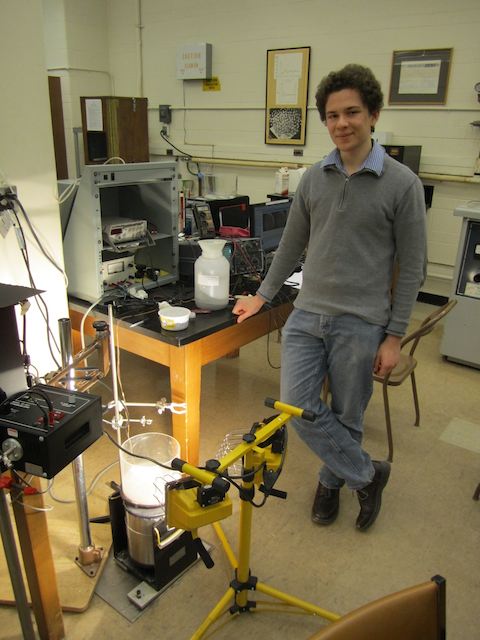
PHY426 student Boris Braverman working on an earlier version of the the Faraday Instability experiment, 15 February 2011
Last updated on 18 September 2016