
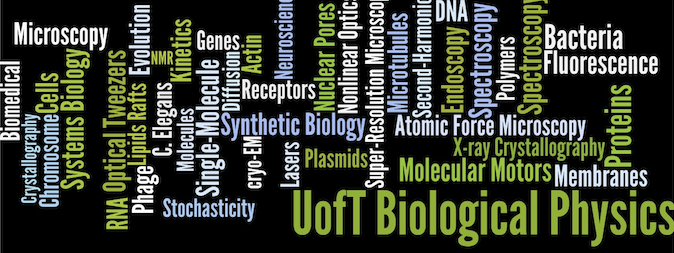
This makes this area of study uniquely interdisciplinary and the research interests of the faculty reflect this diversity. Our research activities span many scales, from single biomolecules, cells, and multi-cellular organisms, and utilize a wide variety of experimental techniques, including multimodal optical microscopy, ultrafast laser spectroscopy, magnetic resonance spectroscopy, computer modeling, machine vision, and computation. Our goal is to describe and understand the complex and fascinating interactions in biological systems from a Physics perspective. If you are interested in the fundamental physics underlying complex phenomena of Biology and want to join a interdisciplinary, fast-growing area of science, Biological Physics is for you.
Biological Physics
Biological Physics at the University of Toronto is broadly defined and focuses on problems at the interface of Physics, Chemistry and Biology.